- Home
- About
- Curriculum
- Statutory
- News & Events
- Parents & Carers
- Activities to do at Home
- Opportunities
- Contact


Post-16 consists of two class groups, Students 2 and the Community Classroom. All pupils follow the Key Stage 5 overviews designed by the Subject leads.
Amwell View's Post-16 curriculum is designed to provide an emphasis on transferable skills which are used in future provision and adult life. This includes developing important life and social skills needed for becoming members of the community. Pupils utilise the school charity shop where they can practise work related skills along with visiting local shops to practise money handling, shopping, road safety and travel training where appropriate. Pupils are not expected to wear school uniform for their last two years at school. This is to help with a gradual transition towards college and adulthood. The curriculum includes:
Post 16 classrooms are set up a little differently to the rest of the school. Our Post 16 classrooms are positioned upstairs at either end of the school. The classrooms are larger than most of the other classrooms across the school, with the need for extra resources such as having their own kitchen.
Intent
We have two Post-16 classrooms, Students 2 and the Community Classroom. The Community Classroom is based in Stanstead Abbotts village next to the school Charity shop.
Implementation
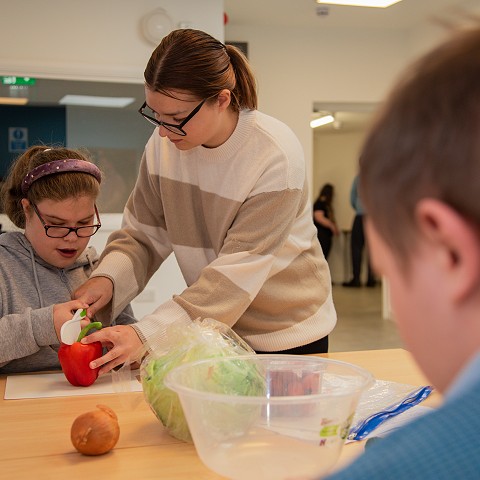
The environment is set up in such a way to allow for fluid micro transitions between activities and also to allow for multiple learning contexts to be taking place as part of the same lesson. An example of this would be how a Careers lesson may include one group working with kitchen appliances, another group learning to recycle and another group learning to hoover and clean, all in different areas of the classroom.
Impact
Pupils have developed independence within their environment and have the necessary skills to maintain and access different areas of the classroom. They have well established routines that allow pupils to follow their own daily routines which include managing their personal hygiene, belongings and learning resources.
Intent
Amwell View's Post-16 curriculum is designed to provide an emphasis on transferable skills used in future provision and adult life. The curriculum has a focus on life and social skills needed for becoming members of the community. The intent for planning looks towards providing pupils with learning opportunities for them to use and apply their learning in multiple contexts in and outside of school.
Implementation
The Post-16 curriculum involves multiple examples of pupils using transferable skills in many different contexts. Pupils learn to develop their skills and apply them in different scenarios, which is often linked to an offsite visit. Significant amounts of their learning revolves around the Careers curriculum. Pupils are introduced to new experiences which enables them to improve their confidence and self-esteem and develop a range of life skills. All of our pupils are set appropriate, pupil centred outcomes which gives them an insight into some of the things that they may experience once leaving school.
Careers, as a subject, is differentiated to meet the needs of each individual pupil. PMLD pupils access Careers through a multi - sensory approach. Pupils have developmental outcomes that are worked towards through experiencing a wide variety of contexts and resources. Skills include; development of object permanence, recognising of self, body awareness, communicating choice and developing a level of independence that is deemed appropriate in relation to the individual.
We have an engaging and varied curriculum, which focuses on off-site visits to different settings, develops pupil’s independence, social skills and supports pupils to access provisions that they may access in the future. These include, the Amwell View Charity Shop, local supermarkets, garden centres and leisure centres. However, Careers is not just about going offsite, it is also about accessing different areas of the school, such as the salon, Food Technology and the Dell. As pupils progress through the Key Stages they experience learning linked to staying healthy, transport, the environment, inventions, famous events, the world around us, leisure activities and celebrations. Careers learning is evident throughout the school curriculum, as pupils learn how to transfer skills from school into a community context.
Pupils in Post-16 have lessons in all of the national curriculum subjects but also aspects of home management, environmental maintenance and they explore the local community as an integral part of their learning experience in Post-16.
Pupils also access additional learning opportunities as specified below:
Selected pupils complete the Arts Award (Bronze) as part of the music curriculum. Students take part in a creative activity they enjoy, go to an arts event, research their arts inspiration and share their skills with others. A selection of students will verbally present their Arts Award portfolio to an external moderator as part of their assessment.
o Amwell Enterprise aims to inspire students to work together as they set up and run their own company. Activities are differentiated for all children to access and the activities aim to encourage students to work together, interact with each other and adults, building their confidence as they set up and run their own business out of the classroom. Pupils both make and sell the items as part of the whole process.
o Mudlarks is an external company that is employed by Amwell View to deliver a weekly horticulture programme of active learning to the students. Students visit Mudlarks community gardens once a week throughout the year to gain further experience outside of the school environment, further developing their community links for life beyond school. This provides a great opportunity for students to make links with a community group who can support them in the future.
o Students are given a wealth of opportunities to engage with meaningful activities that support the transition into further education, adulthood and the local community. Specialist resources are utilised by Post-16 students and support greater impendence allowing students to apply their learning in different contexts.
Impact
Throughout Post-16, pupils will have developed fundamental life and social skills that will equip them for adult life in the community. Careers enables pupils to develop independence to carry out daily tasks and personal care. Pupils confidently use their communication aids and can transfer learning into real life contexts out in the community such as, when at Mudlarks, in the Charity shop and local supermarkets. They now have the necessary skills to communicate with community workers in scenarios they will encounter in the future.
Pupils have experienced planning, organising and hosting a variety of school events including cafés, parties and art workshops. Through this pupils have learnt the skills needed to effectively communicate with less familiar pupils and staff. This also encourages pupils to become active members of the school community and enable others to do the same. These are necessary skills for pupils to become functioning members of society.
The Careers curriculum works in partnership with parents and carers to promote the transfer of skills into their home lives. Pupils are encouraged to participate in home learning activities which support the retention of learning more consistently. This approach supports pupils and their families’ aspirations for the future.
Pupils have had a wealth of opportunities to engage with meaningful activities that support the transition into further education, adulthood and the local community. Specialist resources have been utilised by Post-16 students and have supported them to have greater independence. Pupils have the ability to now to apply their learning in different contexts.
Intent
Pupils are set between 5-8 priority outcomes each term with the intention to focus their learning around their own individual development and progress. Pupils’ outcomes are progressive in nature and work towards preparing them for life after they finish school.
Implementation
Due to the individual learning needs of pupils at Amwell View, pupils in Students 2 and the Community Classroom are set priority outcomes every half term in each of the National Curriculum subjects. Half term planning for Students 2 and Community Classroom embeds each individual learning outcome so they are practised across the curriculum. Teaching Assistants are provided with each pupils’ priority outcomes so they can refer to them in the learning activities and guide and model learning using the carefully considered resources to support achievement of these outcomes.
Impact
The impact of the priority outcomes is recorded at the end of every half term through videos, photos, and comments on Tapestry. They are shared with parents so they can see the progress their child is making each half term and have the opportunity to comment on the observation.
Priority outcomes impact the pupils by providing meaningful steps for them to achieve and make progress in the context of their own ability. They support the development of life and social skills. They are set with the intention for the outcomes to be transferable to multiple contexts, which challenge pupils to apply their learning in new environments. The aim is for pupils to master skills learnt in the classroom and apply them to the community environment.
Intent
Assessment is used formatively and summatively to record and review the progress of pupils. This reviewing ensures that pupils are being set appropriate outcomes to support progress and to create next steps so pupils make expected progress.
Implementation
The use of Tapestry helps teachers to identify the small-step progression of the children, by taking photographs, video and observations. These highlight the progression of individual skills, as they are taken daily. Once the cycle is complete the use of Tapestry enables parents and teachers to see the progression of each skill from start to finish.
Across the school all pupils will be set personalised priority outcome targets for each subject every half-term. The priority targets set link directly to lesson and half-termly plans. The progress of pupil’s is assessed and recorded daily in lessons through the use of videos and recorded on the success criteria proforma. This information is used to inform planning and next steps. Progress is shared with parents throughout the school using Tapestry.
Teachers within Post-16 create personalised outcomes based on developing independence, self-help and life skills. Pupils work towards achieving particular challenges with their learning activities differentiated to meet their educational needs. An Education, Health and Care Plan (EHCP) review meeting is held with the parents annually to discuss their child’s progress against the EHCP outcomes. These outcomes focus on the child’s individual needs and are in relation to personal development, social and emotional aspects.
Impact
As a direct result of assessing in this way, progress is monitored daily, weekly, half termly and annually. This indicates the clear progression that pupils make with regard to their independence, life and social skills. The assessment tools we use give us a clear picture that help contribute to teachers future planning and aspirations for our pupils.
For all pupils in Post 16, they are enrolled onto the AQA Unit Award Scheme (UAS). It is not a qualification, but UAS allows all pupils to have their achievements formally recognised. Pupils are rewarded with a certificate of achievement each time they successfully complete a unit of learning. This allows us to build up a portfolio of certificates to evidence their skills, knowledge and experience over time. We then share these portfolios with college to help them identify a starting point for when the pupils join them at Post 19. The UAS we use alongside our bespoke curriculum and teachers identify units in which pupils have achieved the necessary criteria as part of their day to day learning.